Background
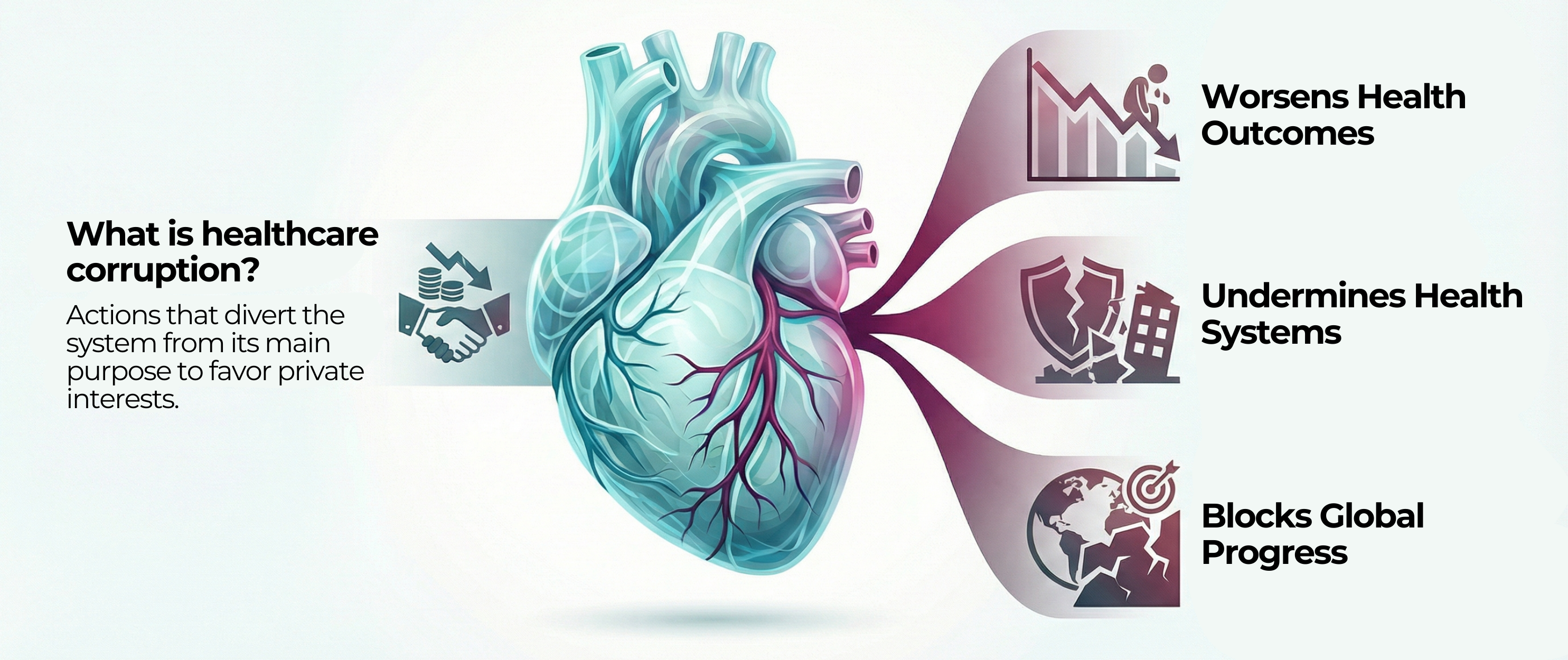
Corruption is a common problem in both high-and low-middle income countries and can make health systems less efficient and trustworthy as well as get in the way of achieving universal health coverage (i.e., making sure everyone has access to needed care) and the Sustainable Development Goals. Corruption in healthcare also leads to worsening health outcomes, including higher infant and child mortality rates and lower life expectancy. When people in charge are corrupt, it also makes it harder for a country's health system to handle health crises like the COVID-19 pandemic and recover after the crisis is over. We define corruption as a set of actions that steers the healthcare system away from its main purpose, ultimately favoring individuals, groups, or organizations.
Scope and Approach
While evidence has been increasing about types and impacts of health sector corruption worldwide, less is known about the situation in the Middle East and North African (MENA) region. We seek to elicit the nature, drivers, and impacts of health system corruption specific to Lebanon and Jordan, and feasible risk-mitigating measures in order to inform health system strengthening efforts. Our focus is on Lebanon and Jordan because both countries have weakened health systems due to crises; health sector corruption is endemic; we can identify patterns when comparing corruption drivers and risks in two countries with very different health systems, societal structures and norms, but similarly high levels of corruption; and critically, there are windows of opportunity with key actors and groups committed to act on corruption.
We will undertake a three-year research programme funded by the National Institute for Health and Care Research (NIHR) to understand the nature, drivers, and impacts of health system corruption in Lebanon and Jordan, and to identify feasible measures to address it. This project is led by the Knowledge to Policy (K2P) Center at the American University of Beirut, in collaboration with Jordan University of Science and Technology (JUST) and the London School of Hygiene and Tropical Medicine (LSHTM).
Work Packages
Our proposed research program will bring together individuals from various disciplines, and will cover five work packages (WPs).
We will start with a process to arrive at a shared conceptualization of health sector corruption and its main causes in each country involving different stakeholder groups (WP1); we will then proceed to collaboratively assess and prioritize corruption risks as well as identify good practices/islands of integrity in the health systems of our study countries (WP2); later moving to examine how political factors affect efforts to address corruption (WP3); and coming up with plans and strategies to address the most important corruption risks that fit each country's context (WP4). Finally, we Will work with stakeholders to promote the uptake and use of findings from our research to inform policy and practice. We will engage local communities, practitioners and policymakers throughout the programme to ensure the research is locally-driven and policy-relevant which can strengthen our final research outputs and policy outcomes. Capacity strengthening at different levels to prevent, detect, and respond to corruption risks in the health system is also a priority in our research program.
Through this proposed research programme, we seek to generate momentum and increase the knowledge and action on corruption risk in health systems of our study countries, but also to contribute to the anticorruption efforts in the MENA region and globally.
AUB Policies and Procedures with a Safeguarding Impact
Please find AUB’s complete safeguarding resources in the link provided.