American University of Beirut

Women, Peace and Security Regional Hub

​​​​​​​

    About

    The Women, Peace and Security (WPS) Regional Hub at the Issam Fares Institute for Public Policy and International Affairs (IFI) at the American University of Beirut is a regional centre of expertise on the Women, Peace and Security agenda, and the first of its kind in the Arab region.

    How the WPS Regional Hub began

    The WPS Regional Hub began as a project. In late 2020, IFI established a partnership with the UN Women Regional Office for the Arab States and began work on "Democratizing the Women, Peace and Security Agenda," an effort built on a straightforward premise: that a global agenda concerning women in conflict could not be written for the Arab region from outside it, and that research and thinking from within the region had to reach the spaces where the agenda was being shaped. Over the following years that work grew through a range of activities, publications, and convenings, and in 2023 IFI institutionalized it as a standing Women, Peace and Security Regional Hub.

    The WPS Hub was established to fill a geographic gap. Dedicated WPS centers existed in North America, Europe, the United Kingdom, Australia, and Africa, but none in the Arab region, despite the region being among those where the agenda matters most. The WPS Hub is the Arab region's counterpart to those institutions, and its work is grounded in the conviction that the region should be a producer of WPS knowledge and policy, not only a subject of it.

    What began as a single project now runs a permanent regional convening mechanism, a capacity-building programme and alumni network spanning the Arab States, an emerging body of policy work, and a public engagement platform. The premise has not changed. The work has simply grown around it.

    What the WPS Regio​​nal Hub does

    Convening and dialogue. The WPS Hub  convenes practitioners, policymakers, researchers, and civil society through closed dialogues, expert and policy roundtables, public panels, and workshops, and represents the region at international conferences and meetings on WPS. Its standing convening mechanism is the WPS Working Group in the Arab States, which meets in a rotating series of regional dialogues. See WPS events.

    Capacity-building and networks. The WPS Hub  invests in the people who carry the agenda forward, and in developing the pipeline of Arab authors, thinkers, and practitioners working on WPS. The Young Women Peacebuilders Programme has delivered three cohorts of young women from across the Arab States, and its graduates form a sustained regional network that continues well beyond the training itself. The WPS Hub  also runs workshops and trainings on mainstreaming the WPS agenda across sectors, including media and the civil service.

    Public engagement. The WPS Hub  works to make the WPS agenda accessible beyond specialist circles, including through the Diplowomen Podcast, a bilingual series on women mediators, negotiators, ambassadors, and peacemakers in the region.

    Research and policy. The WPS Hub  also develops policy-oriented outputs that bring regional evidence into WPS debates, including a regional White Policy Paper on the implementation of the WPS agenda in the Arab States and reporting from its convenings. It offers scholars and fellows the opportunity to pursue WPS-related researchPartnership. The WPS Hub  works in partnership with the UN Women Regional Office for the Arab States and with a consortium of regional and global institutions, and supports local and regional partners with their own research and activities. These partnerships connect the WPS Hub 's work to the policy spaces where the agenda is decided.

    Why the W​​PS Regional Hub's work matters now

    Since the adoption of UN Security Council Resolution 1325 in October 2000, governments, policy experts, and civil society across the Arab region have worked to implement the WPS agenda. Their efforts have raised the voices of women and established the significance of women's role in achieving sustainable peace. Twenty-five years on, significant challenges and gaps remain, particularly in the conflict-affected contexts of the region, and the agenda itself faces questions of relevance and legitimacy that can only be answered from within the region.

    The WPS Hub works across research, convening, capacity-building, and public engagement, on the premise that these are not separate activities but a single chain: evidence generated in the region should shape the conversations held in the region, those conversations should reach the policy spaces where decisions are made, and the people who carry that work forward should be equipped and connected to do so.

    Co​ntact

    Ms. Lara Sammour

    Programme Coordinator, WPS Regional Hub

    Issam Fares Institute for Public Policy and International Affairs, American University of Beirut

    [email protected]​

    WPS Working Group


    The WPS Working Group in the Arab States is a regional mechanism created to influence and inform WPS policy spaces, and to ensure that the priorities of the Arab region are represented in them.

    The year 2025 marked 25 years since the adoption of UN Security Council Resolution 1325 on the Women, Peace and Security agenda. The anniversary provided an opportunity to assess the relevance of the agenda and its implementation in the evolving context of the Arab region. Despite the progress made, significant challenges and gaps remain in achieving full implementation, particularly in conflict-affected areas. This necessitates a renewed focus on ensuring women's meaningful participation and leadership in peace processes and decision-making at all levels; on addressing the specific needs and priorities of women in conflict and post-conflict settings; and on adapting the WPS agenda to the changing security landscape in the region.

    To address these issues, UN Women and the WPS Regional Hub at the Issam Fares Institute, together with a consortium of regional and global partners, established the WPS Working Group in June 2024, with the aim of creating a regional mechanism to influence and inform WPS policy spaces in preparation for the 25th anniversary of the agenda. A series of consultations with a diverse group of WPS stakeholders from the region was undertaken in 2024 and 2025 to analyze existing WPS frameworks and identify gaps in implementation. The main findings and recommendations of those meetings were captured in a regional White Policy Paper, adopted at the fourth dialogue in Abu Dhabi and presented during the UN Security Council Open Debate on Women, Peace and Security in October 2025.

    The main outcome of the Working Group is to provide concrete policy recommendations for strengthening the implementation of the WPS agenda in the Arab region, captured in meeting outcome documents. The Working Group also facilitates enhanced regional cooperation and collaboration among its members, including by encouraging joint advocacy, in order to increase the visibility and influence of the Arab region in global WPS discourse. In 2026, the organizing partners are continuing to convene the group to facilitate ongoing policy dialogues on WPS issues in the region and to build on the advocacy and visibility of Arab women's leadership.

    Membe​rship

    The Working Group membership consists of WPS practitioners, policy experts, academics, peacebuilders, and representatives of the private sector, drawn mainly from conflict-affected contexts in the region. Membership is composed to ensure that women's diverse voices from the region are mainstreamed in peace and security policy discourse at all levels, and particularly at the highest decision-making levels.

    Organizing p​​artners

    The organization of the WPS Working Group is led by the Issam Fares Institute together with the UN Women Regional Office for the Arab States. The Working Group further benefits from the collaboration of regional and global partners, including the Swedish Dialogue Institute for the Middle East and North Africa (SDI), the Deutsche Gesellschaft für Internationale Zusammenarbeit GIZ GmbH, the Arab Reform Initiative (ARI), the Friedrich-Ebert-Stiftung MENA (FES), the Middle East Council on Global Affairs, and the Anwar Gargash Diplomatic Academy (AGDA). The initiative has also previously been supported by the Embassy of Switzerland in Lebanon and Inclusive Peace. This collaboration ensures access to the expertise and resources that support the group's activities.

    For​​mat

    The Working Group convenes through a series of two to three day in-person dialogues. Each dialogue session brings together 15 to 18 participants, chosen on a rotational basis. Following the completion of the fourth dialogue, meetings are held under specific themes, which may include women's leadership in post-conflict transition; gender and disaster risk reduction; gender, climate and security; and women in mediation.

    Dialogu​​es

    First Dialogue  |  Amman, Jordan  |  5-6 June 2024

    The inaugural meeting of the Working Group, hosted by the Swedish Dialogue Institute for the Middle East and North Africa. The meeting opened the series of consultations aimed at analyzing existing WPS frameworks, identifying gaps and challenges, and developing concrete recommendations for implementation across the region. The first draft of the White Policy Paper was developed here.

    Read the press release | Report link

    Second Dialogue  |  Geneva, Switzerland  |  30 September - 2 October 2024

    The second meeting, hosted at the offices of the Friedrich-Ebert-Stiftung and convened to further develop the White Policy Paper drafted in Amman. The meeting coincided with the 57th session of the Human Rights Council, allowing participants to attend the Council's annual discussions on gender and to engage with international stakeholders in Geneva, including the Women, Peace and Humanitarian Fund, the United Nations Institute for Disarmament Research, and the Office of the High Commissioner for Human Rights.

    Read the press release | Report link

    Third Dialogue  |  Doha, Qatar  |  27-29 January 2025

    The third meeting, held at the offices of the Middle East Council on Global Affairs. Discussions addressed key challenges and priorities for the WPS agenda in the region, the potential of WPS National Action Plans as strategic tools, and the approach of the 30th anniversary of the Beijing Declaration and the 25th anniversary of UNSCR 1325. The meeting concluded with external engagements with Doha-based stakeholders to advocate for the White Policy Paper's recommendations.

    Read the press release | Read the report

    Fourth Dialogue  |  Abu Dhabi, United Arab Emirates  |  10-12 September 2025

    The fourth meeting, co-hosted by the Anwar Gargash Diplomatic Academy and the Emirates Center for Strategic Studies and Research, bringing together over 20 women peace actors, policy experts, and practitioners from across the region. The meeting finalised and adopted the regional White Policy Paper, developed through the consultations of 2024 and 2025, which was subsequently presented at the UN Security Council Open Debate on Women, Peace and Security in October 2025.

    Read the press release  |  AUB press release | Read the report

    Donor recognition

    The WPS Working Group is supported through funding from the German Federal Ministry for Economic Cooperation and Development (BMZ) and supported by the Deutsche Gesellschaft für Internationale Zusammenarbeit (GIZ) GmbH, and has previously been supported through funding from the Ministry for Foreign Affairs of Finland. This initiative is also supported by the Friedrich-Ebert-Stiftung as part of the BMZ special means fund to address core reasons of flight and migration. Other organizing partners also play a vital role by contributing financially to the organization of meetings for the WPS Working Group, ensuring the success and continuity of these collaborative efforts.​

    Young Women Peacebuilders


    ​

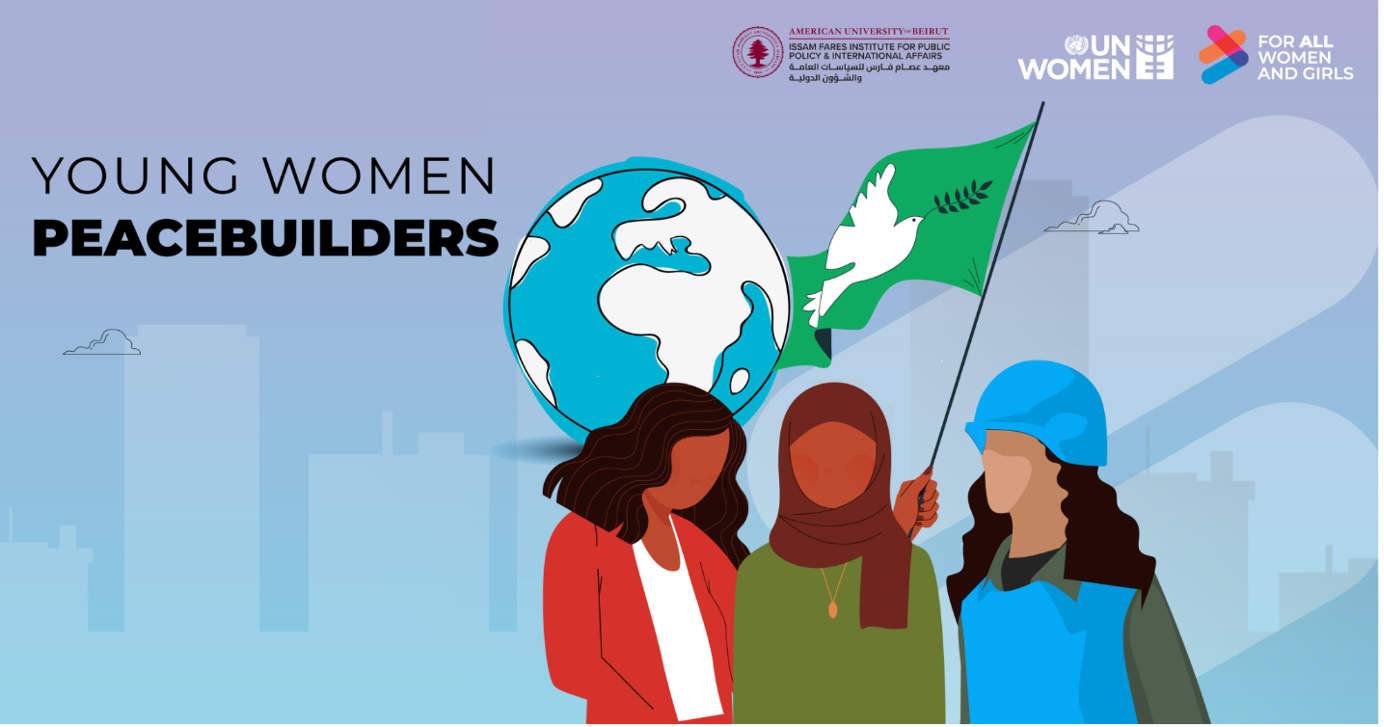
    Sustainable peace requires women's full and meaningful participation in conflict prevention, resolution, and peacebuilding efforts. Young women across the Arab States are already playing active roles in their communities and in crisis settings, bringing critical perspectives, innovative approaches, and a strong commitment to inclusive solutions in the field of peace and security.

    The Young Women Peacebuilders (YWP) Programme, launched in 2021, is a regional initiative jointly implemented by UN Women's Regional Office for the Arab States and the Issam Fares Institute for Public Policy and International Affairs at the American University of Beirut. The programme engages young women as active contributors to peace, governance, and social change, with a focus on strengthening their leadership in complex and conflict-affected contexts.

    Through structured learning, engagement with practitioners, and collaborative exchange, the Programme supports participants in developing practical skills in peacebuilding, mediation, advocacy, and policy engagement. It also fosters cross-border learning and peer solidarity, enabling participants to build lasting networks beyond the duration of the programme.

    Since its launch, the Programme has delivered three cohorts, in 2021, 2023, and 2025, establishing itself as a key regional platform for advancing young women's leadership in peace and security.

    Obje​ctives

    •     Establish a regional community of young women engaged in peace and security work.

    •     Strengthen understanding of the Women, Peace and Security (WPS) and Youth, Peace and Security (YPS) agendas and their relevance to national and community-level peacebuilding.

    •     Enhance participants' ability to analyse conflict through multiple theoretical lenses, using feminist, political, and strategic approaches, and by applying conflict resolution models.

    •     Equip participants to design collaborative peacebuilding initiatives, including stakeholder mapping, identifying root causes of conflict and barriers to peace, and producing policy-oriented recommendations grounded in SMART principles (specific, measurable, achievable, relevant, and time-bound).

    •     Promote peer learning through experience sharing, reflection, and cross-country collaboration.

    •     Provide access to mediation experts, practitioners, and policy actors, and facilitate mentorship and professional networking opportunities.

    Deliv​​​​ery

    The Programme is delivered online and in Arabic, enabling participation from across the Arab States. It adopts a blended learning approach combining live sessions, independent study, and collaborative group work. It is open to women aged 18 to 35 who are nationals of a Member State within the UN Women Arab States area of responsibility.

    2023 Co​hort

    The second cohort ran throughout August 2023, delivering 50 hours of online learning to 46 young women aged 18 to 35 from 13 countries across the Arab States. Facilitated by Lina Kreidie, PhD, and delivered entirely in Arabic, the programme covered conflict resolution methods, peace theories, and mediation approaches. Alongside the coursework, participants took part in mentoring sessions with established women mediators and peace actors from the region, and in networking and knowledge-sharing with their fellow participants.

    The cohort graduated on 31 August 2023 in an online ceremony that marked not only the completion of the programme but the launch of the Young Women Peacebuilders Network.

    2025 C​ohort

    The third cohort ran from 11 to 21 August 2025, followed by a week dedicated to group work and the finalisation of a graduation project, with the graduation ceremony held on 28 August 2025. Delivered in Arabic and online, the cohort was designed to select 30 to 35 young women, with priority given to applicants from Syria, Iraq, Libya, and Yemen, and was open to applicants who had not previously taken part in the programme.

    The cohort graduated on 1 September 2025 during an online ceremony, where 22 exceptional young women from Algeria, Bahrain, Egypt, Iraq, Jordan, Kuwait, Lebanon, Libya, Morocco, Palestine, Syria, and Yemen celebrated the successful completion of the programme, underscoring its commitment to fostering regional cooperation and inclusive leadership.

    The Young W​omen Peacebuilders Network

    Participation in the YWP Programme marks the beginning of continued engagement. Graduates become part of the Young Women Peacebuilders Network, established by the Issam Fares Institute for Public Policy and International Affairs in collaboration with the UN Women Regional Office for the Arab States in 2023, and open to alumni of all programme cohorts.

    The Network supports ongoing learning and collaboration by connecting young women across the region who are working on peace and security. It provides a platform for knowledge exchange, peer support, and engagement with innovative approaches to reconciliation, conflict transformation, and prevention. Members connect through virtual meetings for peer exchange, training, and networking, and continue their skill-building and leadership development through mentorship and capacity sharing beyond the training itself.

    Currently comprising around 115+ members, the Network continues to grow as a regional community advancing inclusive and women-led processes.

    Network meetings          

    The following timeline serves as a living record of key milestones, capacity-building sessions, and regional convenings for the Young Women Peacebuilders Network. It is continuously updated to track ongoing cross-cohort alignment, thematic workshops, and emerging peacebuilding priorities across the region.

    DateTitle / EventDescription & Key Details
    20 Dec 2024Inaugural Joint Meeting (2021 & 2023 Cohorts)The two cohorts brought together around a shared network set-up and road map.
    28 Feb 2025Mentoring Session: Commission on the Status of WomenKeynote by Ms. Corine Kiame, President of the Lebanese League for Women in Business.
    27 May 2025Mentoring Session: WPS and ClimateKeynotes by Ms. Agata Walczak and Ms. Gihan Abou Zeid on how climate insecurity intersects with peace and security.
    20 Dec 2025Joint Meeting of All Three CohortsThe 2021, 2023, and 2025 cohorts convened together for the first time to align around a shared road map.
    24 Feb 2026Artificial Intelligence and PeacebuildingVirtual meeting led by Mr. Emad Karim, UN Women, gathering 41 members online.
    12–13 May 2026Regional Workshop in Cairo (In-person)A two-day in-person workshop convening ~20 young women peacebuilders across the Arab States (sessions on local peacebuilding, displacement, climate security, public speaking, and mental health).
    7 Jul 2026Digital Protection of Women Human Rights DefendersSession by digital safety consultant Noor Khaled, followed by a UN Women presentation on the WPHF funding window.

    Donor re​​cognition

    This initiative is part of the "Enhancing Women's Leadership for Sustainable Peace in Fragile Contexts in the MENA region" programme, funded by the German Federal Ministry for Economic Cooperation and Development (BMZ) in cooperation with Deutsche Gesellschaft für Internationale Zusammenarbeit (GIZ) GmbH.

    Events and Activities

    WPS Events ​and Activities

    The WPS Regional Hub convenes events, workshops, panels, and public discussions that bring together researchers, practitioners, and policymakers working on peace and security in the Arab region.

    See all WPS events  |  See all WPS publications​

    Contact Us

    For various questions, please try contacting us via social media first!
    read more

    Privacy Statement

    We take data privacy seriously and adhere to all applicable data privacy laws and regulations.
    read more

    Copyright and Disclaimer

    Written permission is needed to copy or disseminate all or part of the materials on the AUB website.
    read more

    Title IX, Non-Discrimination, and Anti-Discriminatory Harassment

    AUB is committed to providing a safe and respectful environment to all members of its community.
    read more